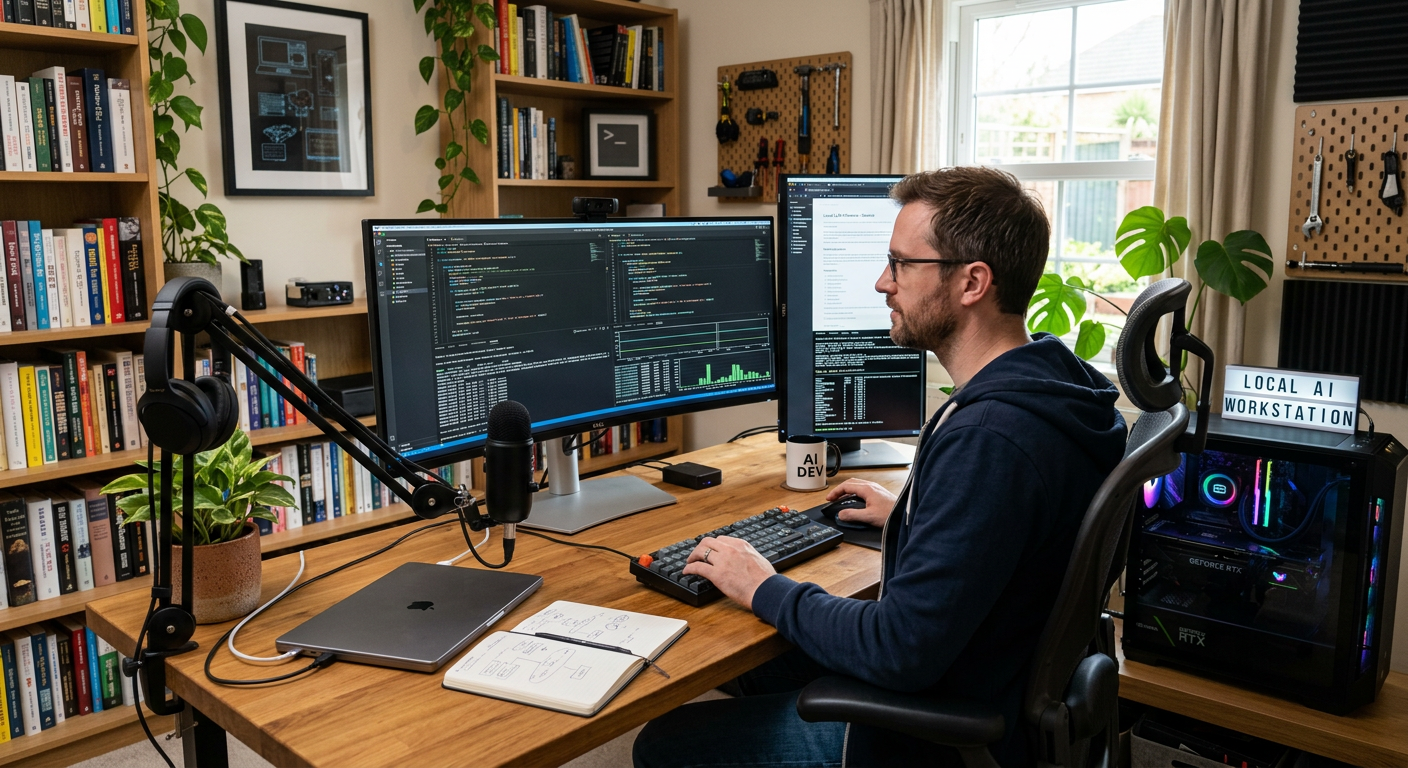
How local AI is becoming the vinyl record of computing and why thousands of creators are unplugging from the cloud.
By the time most people ask an AI to write a poem, summarize a PDF, or generate computer code, the request has usually traveled hundreds—sometimes thousands—of miles into a warehouse-sized data center humming with tens of thousands of GPUs. Massive cooling systems roar around the clock. Electricity consumption rivals that of small towns. Somewhere, a machine you’ve never seen finishes your request and sends the answer back.
But another movement is quietly gaining momentum.
Across bedrooms, garages, music studios, and home offices, artists, programmers, writers, researchers, and musicians are building something different: their own private AI systems.
No subscriptions. No internet required. No monthly token limits.
Just a powerful computer, an open-source language model, and complete control.
It’s becoming the punk rock version of artificial intelligence.
From Stadium Rock to Garage Bands
For years, AI has resembled the major-label music industry.
Gigantic companies own enormous infrastructure. They distribute the product. Everyone else simply streams it.
Local AI flips that model upside down.
Instead of renting intelligence from a corporation, you own the hardware.
It’s remarkably similar to what happened when musicians abandoned expensive recording studios and began producing platinum albums from spare bedrooms.
The same democratization is happening again—only this time it’s intelligence instead of music production.
What Is a Local LLM?
A Local Large Language Model (LLM) is an AI that runs entirely on your own computer.
Nothing leaves your machine.
Your prompts stay private.
Your documents stay private.
Your conversations stay private.
Even if the internet goes down, your AI keeps working.
Popular open-source models now rival commercial systems for many everyday tasks including:
- Writing
- Programming
- Research
- Translation
- Brainstorming
- Data analysis
- Creative storytelling
- Personal knowledge management
The result is an AI assistant that belongs entirely to you.
The Hardware: Your AI Studio
Running AI locally doesn’t necessarily require a data center.
Entry-Level Build
Perfect for experimenting.
- 8-core CPU
- 32 GB RAM
- NVIDIA RTX 4060 (8 GB VRAM)
- 1 TB NVMe SSD
Ideal for 7–8 billion parameter models.
Creator Build
Excellent for writers, musicians, podcasters, and developers.
- AMD Ryzen 9 or Intel Core Ultra processor
- 64 GB RAM
- NVIDIA RTX 5070 or RTX 5080
- 2–4 TB NVMe SSD
Capable of running much larger models with impressive speed.
Power User Workstation
For researchers and professionals.
- AMD Threadripper or equivalent
- 128 GB RAM
- NVIDIA RTX 5090 (or multiple GPUs)
- High-speed SSD storage
- Robust cooling and power supply
This level can comfortably handle advanced reasoning models, multimodal AI, and larger local deployments.
The Software Toolbox
The software ecosystem has matured rapidly, making local AI far easier to use than even two years ago.
Popular components include:
- Ollama for downloading and running models with simple commands.
- LM Studio for a polished desktop interface.
- Open WebUI for a browser-based ChatGPT-like experience.
- Jan for beginner-friendly local AI.
- AnythingLLM for connecting your documents to an AI knowledge base.
- Docker for organizing services into reusable containers.
- Python for automation and custom workflows.
Open-source models from organizations such as Mistral AI, Qwen, DeepSeek, Meta, and Google continue to improve at a remarkable pace, giving users an expanding menu of capable local options.
Why People Are Leaving the Cloud
Privacy is only part of the story.
Running locally offers advantages that many creators find compelling.
Privacy
Sensitive documents never leave your computer.
No Monthly Fees
Once you’ve purchased the hardware, there are no recurring AI usage charges.
Offline Access
Perfect for travel, remote locations, or unreliable internet.
Full Customization
You choose the model.
You choose the interface.
You decide how your AI behaves.
Long-Term Value
A powerful workstation can serve for years while open-source models continue improving.
But It’s Not Perfect
Local AI also comes with trade-offs.
Upfront Cost
A capable machine may cost between $1,500 and $5,000—or more for top-tier builds.
Power Consumption
High-end GPUs consume significant electricity, especially under sustained workloads.
Technical Learning Curve
Installing drivers, configuring software, and selecting the right models requires some patience.
Hardware Limits
The biggest cloud models still exceed what most home computers can run efficiently.
Maintenance
Unlike cloud services, you’re responsible for updates, backups, and troubleshooting.
The Cultural Shift
Technology has a habit of repeating itself.
People bought vinyl after streaming.
Film photography returned after digital cameras.
Cassette tapes found new fans decades after many declared them obsolete.
Now, AI is entering its own independent era.
Just as musicians rediscovered the joy of owning physical media and recording on their own terms, creators are rediscovering the value of owning their intelligence infrastructure.
The movement isn’t driven by nostalgia. It’s driven by autonomy.
Festivals, Fandom, and the DIY Spirit
The rise of local AI echoes the energy seen at maker fairs, open-source conferences, hacker camps, and independent music festivals. These gatherings celebrate experimentation over polish and community over corporate scale. In many ways, today’s home AI builders resemble the early personal-computer hobbyists of the 1970s and the independent musicians who embraced affordable home studios in the 1990s.
That same DIY spirit is now flowing into artificial intelligence.
The Future Lives at Home
Cloud AI isn’t going away.
For the largest models and the most demanding workloads, massive data centers will remain essential.
But for millions of everyday users, the future may look surprisingly personal.
Imagine a computer sitting quietly beside your desk.
It remembers your notes.
Organizes your research.
Helps edit your music.
Writes code.
Answers questions.
Never uploads your work.
Never charges by the token.
Never asks for another subscription.
In a world increasingly defined by rented digital experiences, running a local LLM feels almost rebellious. It’s a reminder that sometimes the most powerful technology isn’t hidden behind warehouse walls—it can live right beside your guitar, your notebooks, and your coffee mug, waiting patiently for the next idea.
The next revolution in AI may not begin in another billion-dollar data center.
It may begin in someone’s spare bedroom.
About The Author