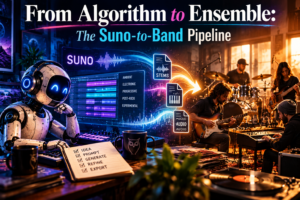
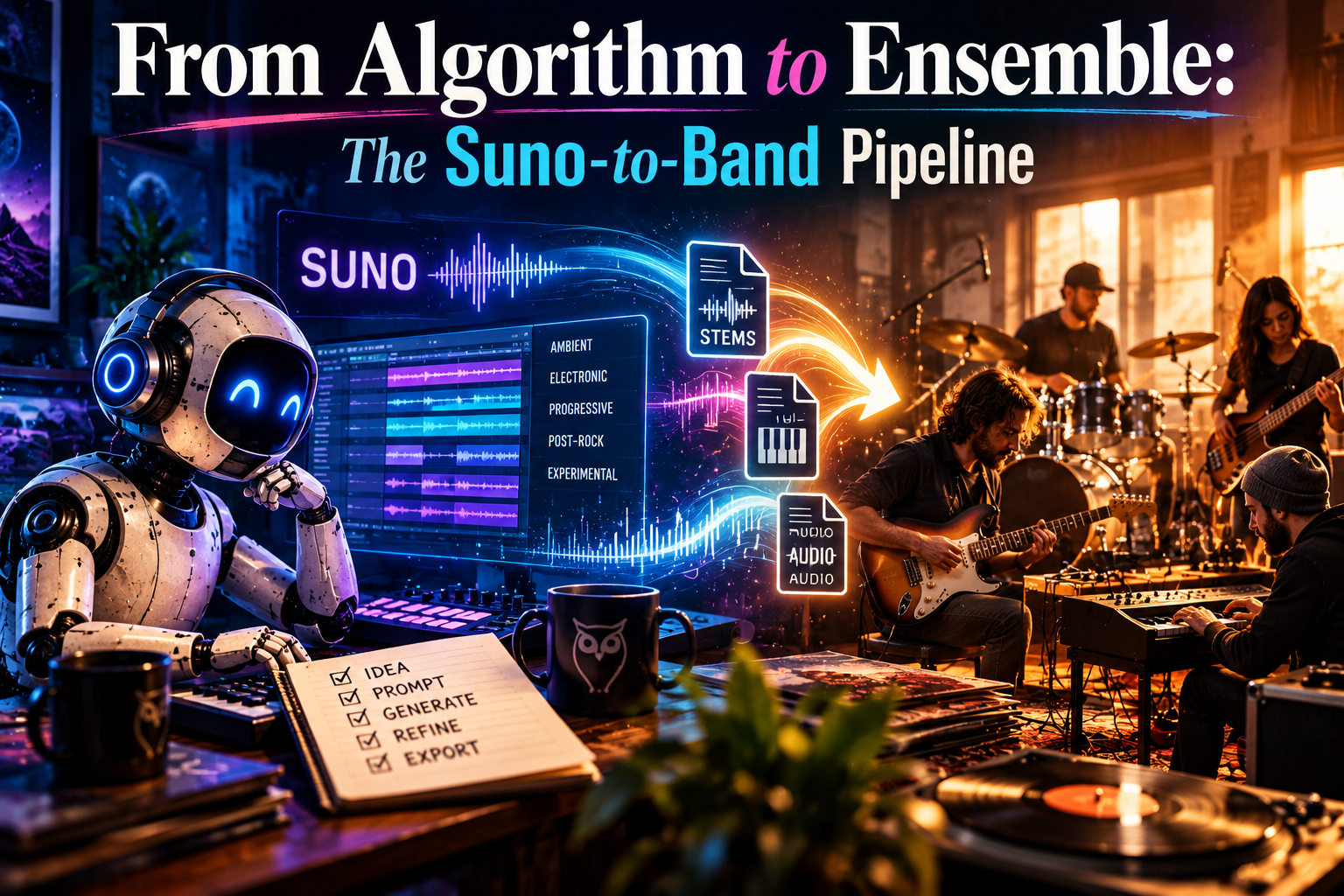
There’s a particular kind of alchemy happening right now in home studios and rehearsal spaces: a songwriter opens Suno, types a prompt, and within seconds has a fully arranged track — vocals, drums, bass, synths, the works — that didn’t exist a minute earlier. Then, instead of stopping there, they hand it to their band. The drummer learns the AI-generated fill. The guitarist works out the AI-generated riff by ear. The singer studies the AI-generated melody and makes it her own. What started as a probabilistic output from a language model ends up, a few rehearsals later, as five people breathing together in a room, playing a song that technically has no human composer.
This workflow scrambles a question we used to think was simple: where does a song come from?
The Origin Point Problem
Traditionally we’ve located a song’s authenticity in its origin — a person with an idea, a guitar, a moment of inspiration. Suno inverts that. The origin is a prompt and a training corpus, a statistical guess at what a song “should” sound like given some parameters. There’s no lived experience behind the lyrics unless the human supplies one, no muscle memory behind the chord voicings, no felt sense of timing behind the groove. It’s origin without origin story.
But something interesting happens the moment a band picks that track up. Rearranging an AI song for live instruments isn’t transcription — it’s translation, and translation is never neutral. A drummer can’t literally reproduce a quantized AI hi-hat pattern; they reproduce their interpretation of it, filtered through their body, their kit, their habits. A vocalist doesn’t clone an AI voice; she finds the phrasing that feels true to her own instrument. Every member makes hundreds of small decisions — where to breathe, where to push the tempo, where to let a note ring out — that the original generation never specified because it couldn’t. AI outputs are frozen; performance is not.
Where the Human Enters
This is the crux of the argument: authorship migrates. It doesn’t disappear, and it doesn’t stay put at the origin — it moves downstream, to the interpretive act. In classical music, nobody argues that a symphony belongs solely to the orchestra because Beethoven only wrote notation and the players supply the sound. We accept a division between composition and performance, and we grant performance real creative status. The Suno-to-band pipeline just makes that division stranger, because the “composer” is a statistical model with no intentions at all, and the performers are doing something closer to co-authorship than to interpretation of a human’s vision.
You could frame it this way: the AI generates a hypothesis about what a song could be. The band tests that hypothesis against physical reality — actual instruments, actual room acoustics, actual human timing — and in doing so, rewrites it. What survives the rehearsal process isn’t the AI’s song anymore. It’s a hybrid object, AI-seeded and human-finished.
The Discomfort, Honestly Addressed
It would be dishonest to write this essay without naming the tension. Some listeners will feel that no amount of downstream humanizing erases the fact that the melody, the chord progression, the lyrical hook — the parts that actually make a song memorable — came from a machine trained on other people’s uncredited work. The band’s contribution, in this view, is skilled labor, not authorship: excellent musicianship in service of someone else’s (or something else’s) idea, the same way a cover band’s virtuosity doesn’t make the song theirs. That’s a real objection, not a small one, and it maps onto legitimate anxieties about what AI generation means for songwriters who spend years developing a voice that a model can approximate on command.
The counterpoint worth sitting with is that this same objection has been leveled at every act of interpretation throughout music history — cover songs, samples, folk process, standards passed hand to hand until nobody remembers who wrote the first verse. What’s genuinely new isn’t the philosophical question, which is old, but the speed: a band can now go from zero to fully realized arrangement in an afternoon, skipping the slow accretion of ideas that used to be where “songwriting” happened.
A Song With Two Births
Maybe the honest way to describe a Suno-to-band song is that it’s born twice. Once, instantly, as a machine’s best guess. Again, slowly, as a group of people argue, rehearse, and physically inhabit that guess until it fits them. The first birth is origin. The second is the thing that actually makes it a song anyone will remember — the sweat, the disagreement about tempo, the night the bridge finally clicked. AI can generate the blueprint. It still takes a room full of humans to build the house you’d actually want to live in.
About The Author