Cold Open: Storm Chasers With Mics
By M-zine staff
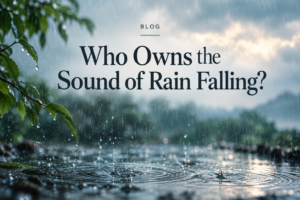
Somewhere in the Pacific Northwest, a guy in a soggy hoodie is crouched under a carport at 3 a.m., holding a $300 field recorder like it’s the Holy Grail. He’s not chasing tornadoes. He’s chasing the perfect patter: rain on a tin roof, no traffic, no dog barking, no neighbor’s leaf blower. Eight hours of it, if the clouds cooperate.
By next week, his storm will be soothing insomniacs in Ohio, studying teens in Seoul and a colicky baby in Brazil. It will rack up millions of plays. And it will raise a question that sounds like a stoner’s 2 m. epiphany but is actually worth real money: who owns the sound of rain?
Not God. Not the sky. Not, legally speaking, the rain. But follow the cash, and you’ll find a booming, slightly absurd industry where people fight over weather like it’s a hit single.
The Law: The Sky Has No Lawyer
Let’s get the big one out of the way. The rain itself is unownable. Copyright protects human expression, not natural phenomena, and a thunderstorm has never filed a single form with the U.S. Copyright Office.
We even have a test case, courtesy of a grinning monkey. In 2011, a crested macaque named Naruto grabbed photographer David Slater’s camera in Indonesia and snapped a selfie that went massively viral. PETA sued on the monkey’s behalf, and in 2018 the Ninth Circuit ruled that animals have no standing to sue under the Copyright Act (Frieze). The court also scolded PETA for using Naruto as a pawn in its own crusade (FindLaw). If a monkey with a camera can’t own his art, the clouds don’t stand a chance.
But here’s the twist that makes the whole rain economy tick: the recording is a different animal. Copyright attaches to a sound recording the moment someone fixes it in a tangible medium. Choose the mic, the spot, the roof, the gain, the edit, and that particular 3 a.m. downpour, as captured, is yours. Nobody owns rain. Somebody absolutely owns that rain.
Which means the question isn’t really “who owns the sound of rain?” It’s “how do you prove your rain isn’t my rain?” And when every storm sounds roughly like every other storm, that’s where things get gloriously stupid.
The Rain Rush: There’s Gold in Them Thar Clouds
Forget the Gold Rush. This is the Drizzle Rush, and it’s paying better than most indie bands.
In 2022, Bloomberg reported that white-noise podcasters on Spotify could pull in as much as $18,000 a month from ads the platform itself placed, with one creator quitting his day job after earning about $12.25 per thousand listens (Yahoo/Business Insider). By January 2023, these wordless shows of thunderstorms, waves and static were racking up 3 million listening hours a day on Spotify (MusicTech).
Then Spotify did the math and panicked. Internal documents showed the company figured it could add $38 million a year to gross profit by steering listeners away from the noise (MobileSyrup). It didn’t ban them, but it did yank them from its Ambassador Ads program that fall (Digital Music News). Picture a record label realizing its biggest act is a rain cloud, and the rain cloud won’t do press.
The music side got the same treatment. Uploaders had learned to chop noise into 30-second tracks, Spotify’s minimum for a paid stream, and stack them into playlists; Spotify’s own example was whale songs sliced that way so listeners never noticed (Gizmodo). So in April 2024, Spotify raised the minimum length for “functional noise” to two minutes, slashing those payouts to a quarter, and began negotiating to value noise streams below music streams (Digital Music News). Rain, officially, became a second-class citizen of the streaming economy.
That’s the backdrop. When weather pays like a hit single, people start guarding their weather like a hit single.
Rain Wars: When Weather Gets Lawyered Up
Here’s the problem with owning a recording of rain: to a machine, all rain sounds alike. YouTube’s Content ID matches audio fingerprints, and broadband noise like rain, surf or static is close to the most generic sound there is. Register your downpour, and the bot may start “finding” it in everybody else’s.
The white-noise precedent proves it. In 2018, Australian music technologist Sebastian Tomczak’s ten hours of computer-generated static drew five Content ID claims from four claimants, mostly sleep-sound channels, all of whom wanted the ad money rather than a takedown (EFF). The BBC’s coverage of that fiasco also recalled a 2012 case in which a YouTuber was claimed over birdsong in the background of his video (Citi FM, via BBC). Swap the static for a storm, and you’ve got the rain economy’s favorite nightmare: wake up to find someone else collecting on your thunder.
Sound-effects libraries add a second layer of chaos. Countless filmmakers, game designers and YouTubers drop in the same licensed “Heavy Rain 04.wav.” If one uploader registers a track built on that file, every legitimate licensee becomes a potential infringer overnight. You paid for the rain. Someone else is invoicing you for it.
And if you think fighting over rain is peak absurdity, meet the Great Silence Dispute. In 2002, British composer Mike Batt put a silent track called “A One Minute Silence” on an album by his group The Planets and credited it to “Batt/Cage,” a wink at John Cage’s famously silent 1952 piece 4′33″. Cage’s publishers came calling for royalties, and Batt handed over a check on the steps of London’s High Court (Blogcritics). Headlines screamed six figures. Years later, Batt admitted the whole showdown was a publicity stunt and the real payment was a £1,000 donation to the John Cage Trust (BBC, via facts.museum; Wikipedia). Still, the world briefly believed you could pay a fortune for nothing. Rain, at least, makes a noise.
Forecast: Synthetic Storms Ahead
Now add AI to the mix. A generator can spit out a flawless, infinite, never-repeating rainstorm in seconds, no soggy hoodie required. That’s a legal headache with a weather alert attached. U.S. copyright protects human authorship, so a purely machine-made storm may belong to no one at all, the Naruto problem with a power cord. Yet those synthetic storms will still trip the same fingerprint matchers, still compete for the same sleepy listeners, and still feed the same claim machine.
Picture the endgame: a human field recorder, an AI rain generator and a sound-library storm, all nearly indistinguishable, all claiming the same ad pennies on the same sleep video. The bot will pick a winner, and it won’t be the one who stood in the rain.
So who owns the sound of rain falling? Nobody, and everybody, and lately whoever files first. The sky gives it away for free every afternoon, to anyone with a window and the good sense to listen. Maybe that’s the real flex. Before you pay for ten hours of someone else’s storm, try opening a window. No ads, no claims, no lawyers. Just weather, doing its thing, the oldest ambient album on Earth.
About The Author