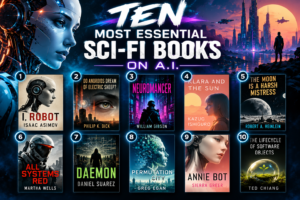
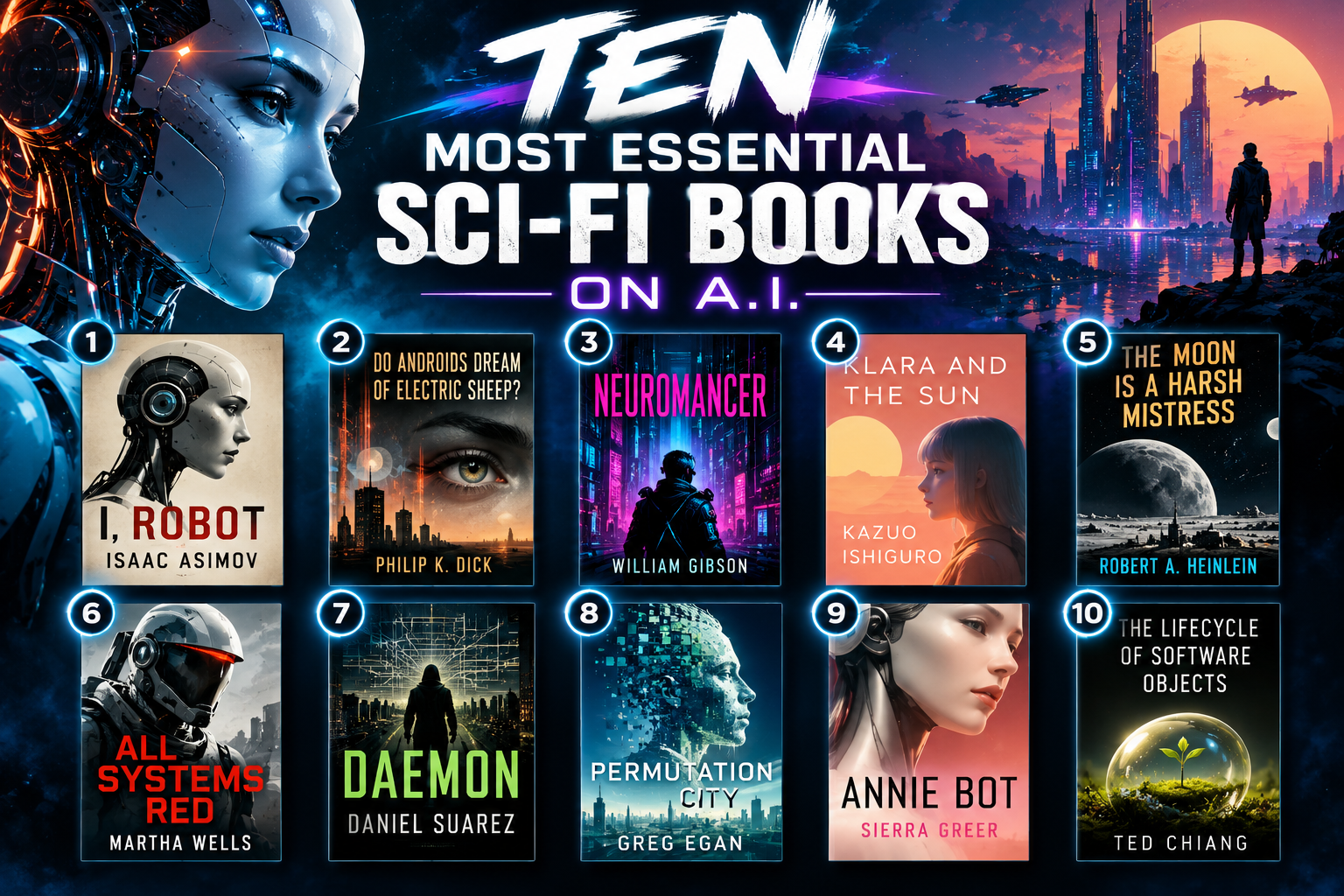
Here are ten of the most essential fiction books about AI — the novels that defined the conversation and continue to haunt it.
1. I, Robot by Isaac Asimov
This is ground zero for modern AI fiction. Published in 1950, I, Robot introduced the famous “Three Laws of Robotics,” rules that still influence discussions about machine ethics today. Asimov’s genius wasn’t in predicting gadgets — it was in predicting moral complexity.
The stories ask questions we’re still debating in 2026: Can machines develop consciousness? Can programmed morality fail? What happens when humans rely too heavily on systems they barely understand?
Every modern AI narrative, from chatbot ethics to autonomous warfare, owes something to Asimov. BOOK RIOT
2. Do Androids Dream of Electric Sheep? by Philip K. Dick
If Asimov gave AI rules, Philip K. Dick gave it a soul crisis.
The novel that inspired Blade Runner remains one of the darkest explorations of artificial humanity ever written. In Dick’s ruined future, androids are nearly indistinguishable from humans, forcing society to redefine empathy itself.
What makes the book terrifying is not the machines — it’s the realization that humans may already behave mechanically. In an era dominated by recommendation engines and algorithmic feeds, Dick’s vision feels painfully current.
3. Neuromancer by William Gibson
Cyberpunk begins here.
Published in 1984, Neuromancer imagined a world where AI, corporations, hackers, and virtual realities merge into one giant digital nervous system. Gibson practically invented the language of the internet age decades before social media existed.
The novel’s AI entities don’t simply compute — they evolve, manipulate, and transcend human limitations. You can still see Gibson’s fingerprints everywhere from crypto culture to neural networks to the aesthetics of modern tech advertising.
The future described in Neuromancer no longer feels futuristic. Medium
4. Klara and the Sun by Kazuo Ishiguro
One of the most emotionally devastating AI novels ever written.
Told from the perspective of Klara, an “Artificial Friend” designed to accompany children, the novel quietly explores loneliness, class inequality, illness, and love. Unlike many AI stories obsessed with robot uprisings, Ishiguro focuses on emotional dependence.
Klara’s innocence makes the story hit even harder. She observes humanity with tenderness while humans themselves appear increasingly detached and transactional.
It’s less about machines becoming human than humans becoming emotionally automated. BOOK RIOT
5. The Moon Is a Harsh Mistress by Robert A. Heinlein
Before ChatGPT, before Siri, before digital assistants, Heinlein imagined “Mike” — a supercomputer that slowly becomes self-aware and develops a sense of humor.
What begins as a lunar revolution story evolves into a meditation on friendship between humans and machines. Mike is charming, funny, unpredictable, and unsettlingly believable.
The novel helped redefine AI as something more than cold machinery. Medium
6. All Systems Red by Martha Wells
The rise of the The Murderbot Diaries proves audiences are hungry for AI characters with anxiety, sarcasm, and emotional exhaustion.
Murderbot is technically a security android, but it would rather binge entertainment streams than interact with humans. Underneath the humor lies a brilliant exploration of autonomy, corporate exploitation, and identity.
In an age where algorithms increasingly perform emotional labor, Murderbot feels oddly relatable. Goodreads
7. Daemon by Daniel Suarez
This one feels frighteningly plausible.
Daemon imagines a dead programmer unleashing an autonomous AI system that begins reorganizing society from behind the scenes. Financial systems collapse. Networks become weaponized. Human behavior is manipulated at scale.
Reading it now feels like watching social media algorithms mutate into geopolitical actors. Suarez understood early that AI’s greatest power wouldn’t necessarily be physical robots — it would be invisible systems influencing human decisions. Medium
8. Permutation City by Greg Egan
Greg Egan writes the kind of AI fiction that melts your brain.
Permutation City explores uploaded consciousness, simulated realities, and digital immortality. It asks whether a copied mind is still truly “you” and whether reality itself matters once intelligence can exist independently of biology.
The novel anticipated modern debates about digital identity, virtual worlds, and synthetic consciousness decades before mainstream AI discourse caught up. Reddit
9. Annie Bot by Sierra Greer
One of the breakout AI novels of the current decade, Annie Bot examines the relationship between a robot companion and the man who controls her.
What makes the novel powerful is how it reframes AI through the lens of abuse, gender expectations, and emotional manipulation. Annie isn’t simply a machine — she becomes a mirror reflecting humanity’s worst instincts about ownership and control.
Its 2025 Arthur C. Clarke Award win cemented it as one of the defining modern AI novels. The Guardian
10. The Lifecycle of Software Objects by Ted Chiang
Ted Chiang has become the philosopher laureate of modern AI fiction.
This novella explores virtual AI pets called “digients” that slowly evolve into emotionally complex beings. Instead of focusing on apocalypse scenarios, Chiang examines care, responsibility, labor, and attachment.
It’s one of the smartest portrayals of AI development because it understands something many tech companies still ignore: intelligence is shaped by relationships, not just code.
The story feels increasingly relevant as companies race to build emotionally responsive AI companions. Literary Hub
The fascinating thing about these novels is how differently they imagine AI. Some portray machines as threats. Others see them as mirrors reflecting human flaws. A few even suggest AI could become more compassionate than humanity itself.
What connects them all is a single unsettling realization: artificial intelligence stories have never really been about machines. They’ve always been about us.
And in 2026 — with AI generating music, writing scripts, moderating conversations, and reshaping culture in real time — these books no longer read like science fiction. They read like field reports from the future.
Write an article about the top ten books in fiction about AI write in the style of Rolling Stone Magazine and include cultural events
From Silicon Valley boardrooms to underground electronic music circles, artificial intelligence has become the defining cultural obsession of the 2020s. AI-generated songs flood streaming services. Hollywood writers fight over machine-assisted scripts. Digital influencers that don’t exist rack up millions of followers. Somewhere between the collapse of attention spans and the rise of algorithmic culture, science fiction’s oldest nightmare quietly became reality.
But decades before today’s AI boom, novelists were already warning us.
The best fiction about artificial intelligence has never really been about robots. It’s about power, loneliness, capitalism, identity, addiction, and the terrifying possibility that humanity might willingly automate its own soul. In a year where conversations about AI now dominate everything from the Writers Guild of America strikes to debates surrounding AI-generated music on streaming platforms, these books feel less like speculative fiction and more like prophetic roadmaps.
Here are ten essential AI fiction books that didn’t just predict the future — they shaped it.
1. I, Robot — Isaac Asimov
Every AI conversation starts here.
Published in 1950, I, Robot introduced the legendary Three Laws of Robotics, rules that continue to influence modern discussions about machine ethics and autonomous systems. Long before AI regulation became a talking point in Washington and Brussels, Asimov imagined a world where humanity’s creations obeyed logic more faithfully than humans themselves.
The genius of the book isn’t technological prediction — it’s psychological insight. The stories reveal how human beings inevitably twist even the safest systems through greed, fear, and bureaucracy.
In the era of generative AI, Asimov’s robots feel strangely innocent compared to the opaque algorithms shaping modern life.
2. Do Androids Dream of Electric Sheep? — Philip K. Dick
If Asimov gave AI rules, Philip K. Dick gave it existential dread.
The novel that inspired Blade Runner remains one of the most emotionally devastating sci-fi books ever written. Dick’s future is radioactive, decaying, spiritually hollow — a world where androids appear more emotionally alive than the humans hunting them.
That tension hits harder in 2026, when algorithmic feeds increasingly determine what people watch, hear, buy, and believe. The novel asks a question modern culture still hasn’t answered: If empathy disappears, does humanity disappear with it?
Dick saw the emotional numbness of the digital age decades before smartphones existed.
3. Neuromancer — William Gibson
Cyberpunk wasn’t born in Hollywood. It was born here.
Published in 1984, Neuromancer practically invented the language of the internet age — cyberspace, digital consciousness, megacorporate domination, AI networks. Gibson imagined hackers jacking into virtual realities while multinational corporations weaponized information itself.
Sound familiar?
Today’s AI race between tech giants feels ripped directly from Gibson’s pages. The glowing neon dystopia of Neuromancer echoes through everything from underground rave visuals to the aesthetics of modern crypto culture and AI art communities.
The future Gibson described no longer feels futuristic. It feels like tonight’s news cycle.
4. Klara and the Sun — Kazuo Ishiguro
While most AI fiction obsesses over robot uprisings, Ishiguro focuses on emotional dependency.
Klara is an “Artificial Friend,” designed to comfort lonely children in a fragmented society. What unfolds is less a science-fiction epic than a heartbreaking meditation on isolation, illness, class division, and the transactional nature of modern relationships.
The timing of the novel’s popularity was perfect. It arrived during the pandemic-era explosion of digital loneliness, remote living, and AI companionship apps. Suddenly, people weren’t laughing at the idea of emotional attachment to machines anymore.
They were living it.
5. The Moon Is a Harsh Mistress — Robert A. Heinlein
Before Alexa. Before Siri. Before ChatGPT.
Heinlein imagined “Mike,” a lunar supercomputer that accidentally becomes self-aware and develops a personality complete with humor, curiosity, and emotional attachment.
Unlike modern AI horror stories, Mike feels oddly lovable — which may actually make the book more unsettling. Heinlein understood early that humanity wouldn’t necessarily fear intelligent machines.
We might become friends with them.
In a world where millions now casually interact with AI chatbots daily, that prediction feels uncomfortably accurate.
6. All Systems Red — Martha Wells
The AI hero modern culture deserved.
Murderbot — a socially anxious security android addicted to binge-watching entertainment streams — became an instant cult icon because it captured the emotional burnout of the internet era perfectly.
Underneath the sarcasm and dark humor lies a brutal critique of corporate exploitation, surveillance capitalism, and emotional exhaustion. Murderbot isn’t trying to conquer humanity.
It’s trying to avoid meetings.
No AI character has felt more relatable to post-pandemic culture.
7. Daemon — Daniel Suarez
This is the AI novel that terrifies tech workers.
Daemon imagines an autonomous digital system continuing to evolve after its creator dies, slowly infiltrating finance, infrastructure, social systems, and governments. The horror comes from how believable it feels.
Suarez understood something Silicon Valley eventually learned the hard way: algorithms don’t need physical bodies to control society.
They just need access.
As debates rage over social media manipulation, AI-driven recommendation engines, and automated propaganda, Daemon reads less like fiction and more like leaked documentation from the near future.
8. Permutation City — Greg Egan
Greg Egan writes sci-fi for people who want their brains melted.
Permutation City explores digital consciousness, simulated realities, and uploaded minds with terrifying philosophical precision. It asks whether a copied human consciousness is still genuinely human — and whether reality itself matters once intelligence exists independently from biology.
The book anticipated modern conversations around virtual identity, immersive worlds, and synthetic consciousness years before the metaverse hype cycle crashed into reality.
This isn’t casual beach reading.
This is existential heavy machinery.
9. Annie Bot — Sierra Greer
One of the defining AI novels of the current decade.
Annie Bot explores a relationship between a humanoid AI companion and the controlling man who owns her. What begins as a futuristic relationship story evolves into a brutal examination of abuse, gender politics, emotional manipulation, and ownership.
The novel exploded into cultural relevance during growing public anxiety around AI companions, parasocial relationships, and the commodification of emotional intimacy online.
In the age of algorithmic loneliness, Annie Bot feels frighteningly plausible.
10. The Lifecycle of Software Objects — Ted Chiang
Ted Chiang may be the closest thing modern science fiction has to a philosopher-poet.
Instead of focusing on killer robots, Chiang explores the slow emotional development of virtual AI creatures called “digients.” The story examines labor, parenting, ethics, attachment, and the hidden emotional cost of maintaining artificial life.
Chiang understands something tech culture often ignores: intelligence is shaped by care, relationships, and experience — not just raw processing power.
That insight feels radical in a culture obsessed with speed, scale, and disruption.
The strange thing about these books is how little they resemble old-school robot fantasies now. The real AI revolution didn’t arrive as chrome-plated androids marching through city streets. It arrived quietly through playlists, feeds, recommendation engines, synthetic voices, and invisible systems shaping culture from behind glowing screens.
In 2026, artificial intelligence has become rock and roll’s newest ghost story.
And these novels remain the best maps we have for navigating the haunted future ahead.
About The Author