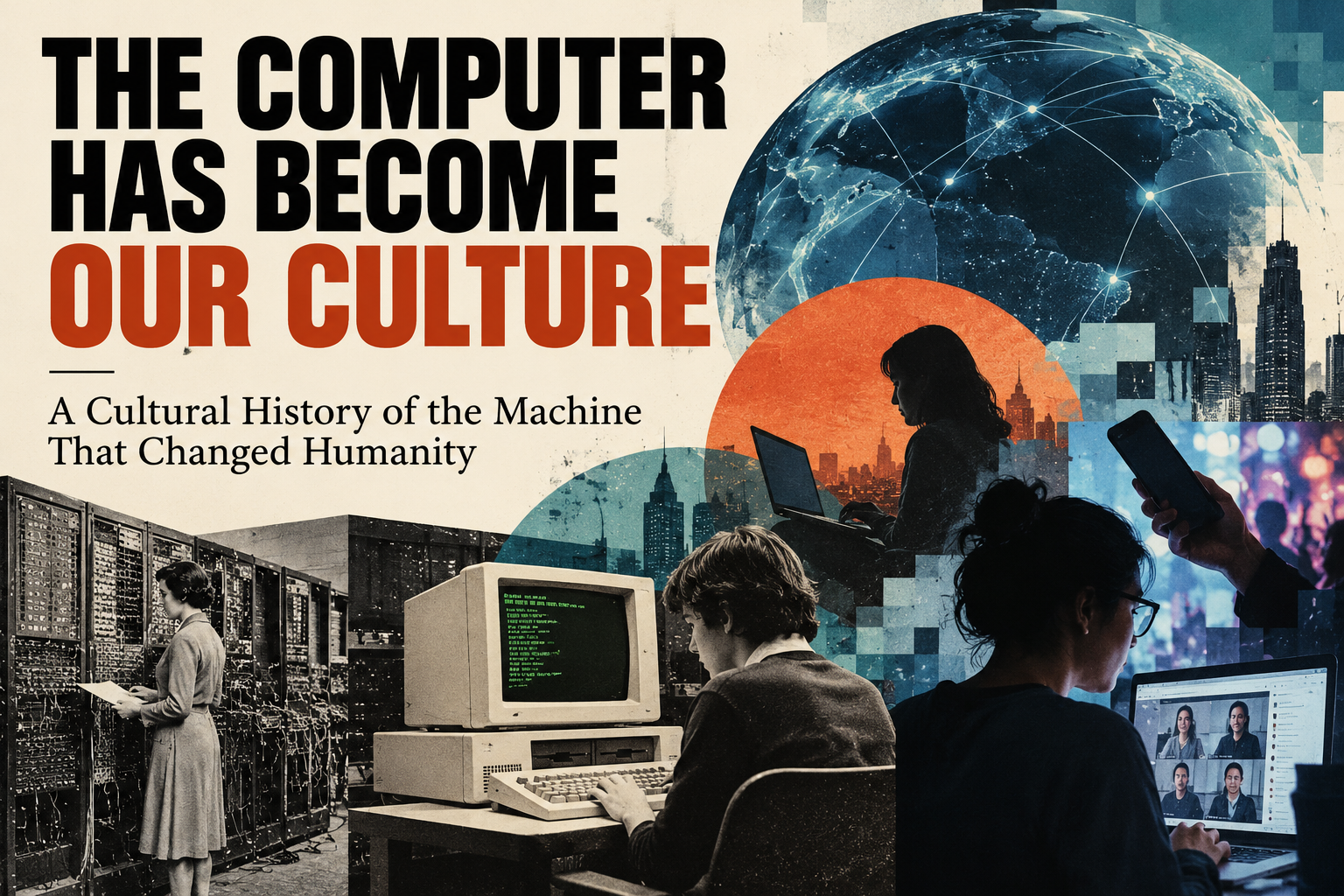
A Cultural History of the Machine That Changed Humanity
M-Zine.com | Computers & Culture in 2026 | Essay Series — Part One
Part One: We Built the Machine. Then the Machine Rebuilt Us.
The personal computer was supposed to liberate the individual. Half a century later, computers influence our relationships, creativity, entertainment, employment, and even our understanding of reality. How did a machine designed to process information become the organizing force of modern civilization?
The Revolution Nobody Fully Understood
In 1975, when the Altair 8800 appeared on the cover of Popular Electronics, the idea of owning a computer seemed almost absurd.
Computers belonged to universities, government laboratories, military installations, and corporations. They occupied entire rooms, demanded specialized knowledge, and cost more than most ordinary people could imagine spending.
They were not cultural objects.
They were calculating machines.
But something extraordinary was beginning to happen in garages, university laboratories, electronics clubs, and the imaginations of a generation that had grown suspicious of centralized authority.
The computer was about to become personal.
And the consequences would reach far beyond technology.
The young enthusiasts gathering around the Homebrew Computer Club in California were not simply building machines. They were participating in a movement that would eventually transform the relationship between individuals, information, and power.
The personal computer represented a radical proposition: computing power could belong to ordinary people.
This was a remarkable departure from the mainframe era, when access to computing resources was controlled by institutions.
The dream was decentralization.
The dream was independence.
The dream was that individuals, equipped with sufficiently powerful machines, could accomplish things previously reserved for large organizations.
What almost nobody anticipated was that personal computing would eventually create some of the largest and most influential corporate institutions in human history.
The machine that promised independence would also become an instrument of dependence.
That contradiction sits at the center of computer culture in 2026.
The Counterculture Meets the Microprocessor
The personal-computer revolution did not emerge in isolation.
It developed against the cultural background of the 1960s and 1970s, a period defined by political protest, experimentation, changing social values, and growing skepticism toward traditional institutions.
The same American society that witnessed the civil rights movement, antiwar demonstrations, and the rise of alternative communities was also witnessing a technological transformation.
The connection was not accidental.
Some influential early computer enthusiasts imagined technology as a means of personal empowerment rather than institutional control.
Stewart Brand’s Whole Earth Catalog, first published in 1968, helped popularize the idea that access to tools and information could expand individual autonomy.
The publication’s famous emphasis on access to tools anticipated a central belief of personal-computer culture.
Knowledge should not remain locked inside institutions.
Technology should be something individuals could use for themselves.
In this environment, the computer began acquiring an identity that extended beyond engineering.
It became a symbol of possibility.
For some, it represented intellectual freedom. For others, economic opportunity. For still others, the prospect of creating entirely new forms of art and communication.
The machine was no longer merely performing calculations.
It was becoming an expression of cultural values.
And those values were not always compatible.
Freedom and control, openness and ownership, collaboration and competition would become recurring tensions throughout the computer age.
They remain unresolved today.
1984: The Computer Becomes a Cultural Statement
On January 22, 1984, during Super Bowl XVIII, Apple aired its now-famous Macintosh advertisement directed by Ridley Scott.
The commercial borrowed imagery from George Orwell’s dystopian novel Nineteen Eighty-Four.
A crowd of expressionless figures watched a giant authoritarian face on a screen. A lone woman ran forward and hurled a hammer, shattering the image.
The message was unmistakable.
The personal computer would challenge conformity.
Technology would free the individual from centralized authority.
Two days later, Apple introduced the Macintosh.
The commercial became one of the most memorable moments in advertising history, but its deeper significance was cultural.
A computer was being marketed not primarily as a machine, but as an identity.
Buying one could represent independence, creativity, and resistance to the established order.
Computers had entered the world of mythology.
They could now symbolize rebellion, imagination, intelligence, and personal freedom.
The irony would become increasingly apparent over the following decades.
The computer industry that promoted liberation would eventually build tightly controlled ecosystems, proprietary platforms, and subscription-based services.
By 2026, the distinction between technological freedom and technological dependence had become considerably harder to maintain.
When the Computer Entered the Living Room
During the 1980s, computers began appearing in ordinary homes.
The Commodore 64, Apple II, IBM PC, Atari computers, and other machines introduced millions of people to programming, games, digital graphics, and electronic communication.
For many children, the home computer was not primarily a productivity device.
It was a mysterious world waiting to be explored.
You could write programs.
You could create sounds.
You could make pictures.
You could discover how software worked by experimenting, failing, and trying again.
The computer invited curiosity.
There was something fundamentally different about this relationship compared with the increasingly polished devices that would follow.
Early personal computers often demanded participation.
They required users to learn commands, understand storage media, troubleshoot problems, and occasionally open the case.
They were imperfect machines.
But their imperfections encouraged exploration.
A generation learned that computers were not magical objects.
They were systems that could be understood.
In retrospect, this may have been one of the most culturally valuable characteristics of early personal computing.
The machine did not merely provide experiences.
It invited people to construct experiences of their own.
By contrast, much of contemporary computing emphasizes convenience, automation, and frictionless consumption.
The modern user may possess access to computational capabilities that would have astonished an engineer in 1985, yet have little understanding of how those capabilities operate.
We have become extraordinarily skilled at using interfaces.
That is not necessarily the same thing as understanding computers.
The Internet Changes the Meaning of Community
The next great transformation occurred when computers began connecting people rather than merely processing information.
Early bulletin board systems, Usenet communities, academic networks, and commercial online services demonstrated that electronic communication could create relationships independent of physical geography.
By the 1990s, the World Wide Web was accelerating this transformation.
The computer became a doorway.
A person living in a small town could communicate with someone on another continent.
Musicians could exchange recordings.
Writers could publish without traditional gatekeepers.
Collectors could discover communities built around obscure interests.
Knowledge that once required access to specialized libraries could increasingly be located from home.
The possibilities were genuinely revolutionary.
Yet another transformation was unfolding beneath the surface.
Human culture was beginning to migrate into digital environments.
Conversations that once occurred in cafés, record stores, classrooms, and community centers increasingly took place through computer networks.
This did not eliminate physical culture.
But it created a second cultural geography.
People could now belong to communities they might never encounter in person.
Identity itself began expanding beyond the physical world.
A person could be a programmer in one online community, a musician in another, and an anonymous participant in a third.
The internet introduced new opportunities for self-expression.
It also introduced new questions about authenticity, anonymity, trust, and social responsibility.
Those questions would become central to digital life.
The Great Transformation: From Tool to Environment
The most important change in computer culture may have occurred so gradually that we barely noticed it.
Computers stopped being things we deliberately sat down to use.
They became environments we inhabited.
In the early personal-computer era, using a computer usually required a conscious decision.
You approached the machine.
You switched it on.
You performed a task.
You switched it off.
There was a clear distinction between computer time and ordinary life.
That distinction has largely disappeared.
By 2026, computers are embedded in automobiles, household appliances, communication systems, medical equipment, financial transactions, entertainment services, and public infrastructure.
The smartphone accelerated this transformation by placing networked computing in our pockets.
We no longer need to visit the computer.
The computer accompanies us.
It wakes us in the morning.
It delivers the news.
It recommends music.
It tracks appointments.
It helps us navigate cities.
It mediates conversations.
It records photographs.
It offers entertainment during moments of boredom.
Increasingly, it assists with writing, research, decision-making, and creative work.
The computer has become the intermediary between the individual and much of modern life.
This is not simply a technological change.
It is a cultural transformation of extraordinary magnitude.
Because when a technology becomes the environment through which we experience the world, it begins influencing how we interpret that world.
Culture Becomes Computable
Consider music.
For most of the twentieth century, recorded music was experienced through physical objects and broadcast media.
Records, tapes, compact discs, radio stations, and music publications helped organize musical culture.
The arrival of digital recording and the MP3 changed the economics and distribution of music.
Streaming changed something deeper.
Music became a continuously accessible database.
Songs could be searched, ranked, recommended, skipped, repeated, categorized, and analyzed.
Listeners gained unprecedented access to recordings.
But listening behavior also became measurable.
The cultural experience of music was increasingly translated into data.
A listener’s preferences could be represented by patterns of engagement.
A song’s commercial performance could be influenced by playlist placement and recommendation systems.
Artists could find themselves responding not only to audiences but also to the metrics used by platforms.
The same process affected film, television, journalism, literature, and visual art.
Cultural works became objects within computational systems.
And those systems increasingly influenced which works audiences encountered.
This represents one of the defining developments of the twenty-first century.
Computers no longer merely distribute culture.
They participate in organizing cultural attention.
That distinction matters.
A record store clerk recommending an obscure album and a recommendation algorithm suggesting a recording may produce similar immediate outcomes.
But the underlying relationships are different.
One is a human exchange shaped by conversation, memory, enthusiasm, and personal judgment.
The other is a computational process shaped by data, model design, platform objectives, and user behavior.
Neither must automatically be considered superior.
But they represent different forms of cultural mediation.
And as more cultural discovery becomes automated, understanding those differences becomes increasingly important.
2026: The Machine Begins to Participate
Artificial intelligence introduces another turning point.
For decades, computers helped humans create culture.
They recorded music, edited photographs, assembled films, formatted books, and distributed information.
Now generative systems can produce material that resembles cultural expression itself.
They can generate musical compositions, write essays, create illustrations, synthesize voices, and participate in conversations.
This does not settle the philosophical question of whether machines possess creativity, understanding, or subjective experience.
But it does change the practical relationship between computers and culture.
The machine is no longer confined to storing, processing, or transmitting human-created material.
It can generate new material in response to human direction.
For musicians, writers, artists, and cultural institutions, this creates possibilities alongside difficult questions.
What distinguishes authorship from assistance?
How should creative contributions be credited?
What responsibilities do people have when publishing synthetic media?
How do we preserve human cultural experience while embracing computational capabilities?
And perhaps most importantly:
What happens when the production of cultural material becomes almost unlimited, but human attention remains finite?
The challenge of 2026 is not simply that computers can generate more content.
It is that society must determine how to assign meaning, value, trust, and attention in an environment of extraordinary abundance.
The Machine Reflects the Civilization That Built It
There is a temptation to describe technological change as inevitable.
Computers become faster.
Software becomes more sophisticated.
Networks expand.
Artificial intelligence grows more capable.
Culture adapts.
But this description leaves out the most important participants.
People.
Computers do not emerge independently of society.
They are designed, manufactured, financed, programmed, regulated, purchased, and used by human beings.
Their influence reflects decisions made by corporations, governments, engineers, artists, educators, and ordinary users.
The digital environment we inhabit is not simply the consequence of technological progress.
It is the result of human choices.
Some of those choices have expanded freedom and opportunity.
Others have concentrated power, weakened privacy, or encouraged dependency.
Recognizing this distinction is essential.
Because if computers have become our culture, then the future of computer culture remains a question of human responsibility.
We are not merely spectators watching technological civilization unfold.
We are participants in its construction.
The Question We Should Have Asked
Half a century ago, the personal-computer revolution asked a compelling question:
What could individuals accomplish if they had access to computing power?
That question helped inspire extraordinary innovation.
It expanded education, communication, scientific research, artistic production, and economic opportunity.
But in 2026, another question deserves equal attention.
What kind of civilization are we creating when computers mediate nearly every aspect of human experience?
The answer cannot be measured solely in processing speed, market capitalization, software adoption, or the number of AI-generated images produced each day.
It must also be measured in human terms.
Are we more curious?
Are we more independent?
Are we better informed?
Do we understand the tools we depend upon?
Are we creating more meaningful art?
Are we building stronger communities?
Do we have greater control over our time, attention, and cultural lives?
These questions may prove more important than the specifications of the next computer or the capabilities of the next artificial intelligence model.
Because the greatest achievement of the computer age should not be the creation of machines that can do everything.
It should be the creation of a civilization in which people can do more, understand more, and live more meaningful lives.
We built computers to expand human possibilities.
We should be careful not to construct a culture that gradually reduces them.
The computer has become our culture. The unfinished question is whether we still have the power to decide what that culture becomes.
Coming Next — Part Two
The Personal Computer and the Death of the Electronic Frontier
How the rebellious, experimental world of early personal computing evolved into an economy of corporate platforms, rented software, digital surveillance, and carefully controlled technological ecosystems.
We’ll explore the Homebrew Computer Club, the rise of Microsoft and Apple, the hacker ethic, the early internet, and the historical turning points that transformed the personal computer from a symbol of independence into an essential gateway to corporate digital infrastructure.
About The Author