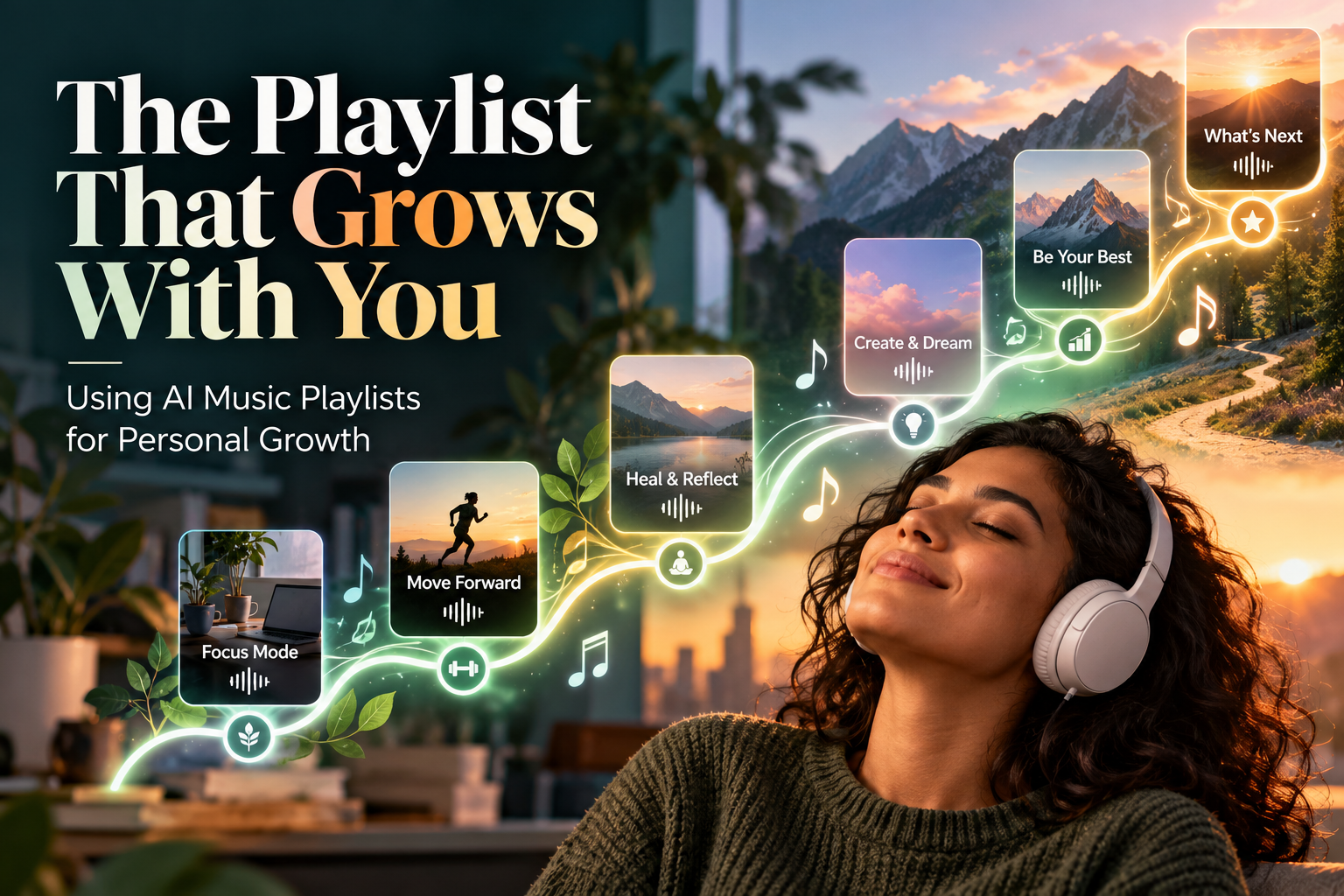
Using AI Music Playlists for Personal Growth
For most of recorded-music history, a playlist has meant something fairly simple: a collection of songs we want to hear.
We made mixtapes for road trips. We burned CDs for friends. We assembled workout playlists, breakup playlists, party playlists and collections of songs designed to get us through long nights at work.
Artificial intelligence introduces a different possibility.
What if a playlist were not organized primarily around genre, artist or popularity?
What if it were organized around who you are trying to become?
An AI-assisted personal-growth playlist could be built around concentration, reflection, creativity, confidence, recovery, curiosity, patience or simply learning how to sit quietly for an hour without reaching for another distraction.
The playlist becomes less like a jukebox.
It becomes an environment.
Music Has Always Been Personal Technology
Long before anyone used the phrase “artificial intelligence,” people were already using music to regulate their internal lives.
Work songs established rhythm.
Religious music created spaces for contemplation.
Military music encouraged collective movement.
Lullabies calmed children.
Dance music brought communities together.
Blues gave shape to grief. Punk converted frustration into energy. Ambient music made stillness itself something worth listening to.
The technological containers changed along the way.
The phonograph allowed people to replay performances.
Radio transformed music into a continuous stream.
The LP encouraged extended listening.
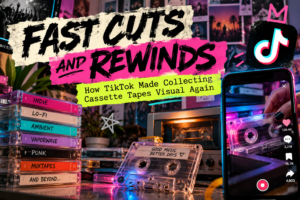
The cassette made personal sequencing remarkably easy.
The Walkman turned music into a private mobile environment.
The iPod placed thousands of songs in a pocket.
Streaming platforms effectively removed the limits of the personal record collection.
And now AI potentially introduces another transition:
the adaptive playlist.
Instead of merely choosing songs, listeners can begin describing intentions.
“I need ninety minutes of music that helps me write.”
“I want something for an evening of reflection.”
“Give me a musical progression from anxiety toward calm.”
“Build a two-hour listening session that begins with curiosity, moves through concentration and finishes in silence.”
Those requests represent a fundamentally different relationship with recorded music.
The Mixtape Was the Beginning
One of the most important cultural ancestors of AI playlist building is the humble mixtape.
During the cassette era of the 1970s, 1980s and 1990s, creating a good mixtape required considerable thought.
Someone had to select the recordings.
Someone had to determine their order.
Someone had to understand transitions.
And because a cassette had limited recording time, every song occupied valuable territory.
A mixtape therefore represented something algorithms sometimes struggle to understand:
intentional limitation.
The person making the tape couldn’t include everything.
Choosing one song meant excluding another.
That limitation produced meaning.
The arrival of digital music gradually eliminated those physical constraints. MP3 collections could contain thousands of recordings. Streaming services expanded that universe into tens of millions.
Music became abundant.
But abundance introduced another problem.
When everything is available, choosing becomes work.
The challenge of modern listening is no longer finding enough music.
It is finding meaningful pathways through too much music.
That is where AI could become genuinely interesting.
From Recommendation to Intention
Traditional recommendation systems largely ask:
What will keep this person listening?
A personal-growth system would ask something different:
What does this person want this listening session to accomplish?
Those are not the same objective.
Engagement algorithms often favor familiarity. If you repeatedly listen to a certain style, recommendation systems naturally learn to provide more of it.
That is convenient.
But personal growth frequently requires encountering something unfamiliar.
A listener interested in expanding musical awareness might intentionally request:
“Give me five recordings outside the genres I normally hear.”
Or:
“Create a listening journey through musical cultures I know very little about.”
Or:
“Introduce increasingly challenging music over the next month.”
The goal would no longer be perfect personalization.
It would be productive discomfort.
Brian Eno and Music as Environment
Ambient music provides an especially useful historical connection.
When Brian Eno released Ambient 1: Music for Airports in 1978, the record helped formalize an idea that would become increasingly important: music could function as an environmental condition rather than constantly demanding attention.
That idea becomes surprisingly relevant in the AI era.
An AI-generated personal-growth playlist could treat music almost architecturally.
A morning session might begin with sparse drones.
Gradually introduce acoustic textures.
Move toward gentle rhythmic material.
Increase complexity during the listener’s most productive period.
Then gradually remove rhythmic elements as the session ends.
The listener isn’t simply hearing a collection of favorite songs.
The listener is moving through a designed acoustic space.
For ambient and electronic music in particular, this could become one of AI’s most compelling applications.
The Walkman Changed the Geography of Listening
Another major cultural event arrived in 1979 with the Sony Walkman.
Suddenly music traveled with the listener.
Walking down a street could have a soundtrack.
Riding a train became a private listening session.
The distinction between public environment and private musical environment began to collapse.
The smartphone eventually pushed that idea much further. Music became available almost anywhere, accompanied by an enormous ecosystem of notifications, social media, video and other demands on attention.
That creates a curious contradiction.
We have greater access to music than any previous generation.
Yet sustained listening can be increasingly difficult.
A personal-growth playlist could deliberately resist that environment.
Imagine something called:
The One-Hour Listening Practice.
The rules would be simple.
Put the phone down.
No skipping.
No social media.
No notifications.
No browsing for another album.
Listen.
AI could construct the session, but the human activity would remain ancient:
paying attention.
AI as Musical Librarian
One useful way of thinking about AI in this context is not as a replacement for musicians or human curators.
Think of it as a librarian.
A good librarian doesn’t simply hand you the most popular book.
The librarian listens to what you’re interested in and helps you discover pathways you might not have found independently.
Music libraries could operate similarly.
Someone interested in space music might begin with contemporary ambient recordings.
AI could trace connections backward toward Berlin-school electronic music, minimalist composition, musique concrète, early synthesizer experimentation and eventually composers whose work helped establish the conceptual foundations of those genres.
One listening session creates the path to another.
The playlist becomes educational.
Personal Growth Doesn’t Always Mean Productivity
There is an important danger here.
Modern technology has a tendency to convert every human activity into optimization.
Sleep becomes optimized.
Exercise becomes quantified.
Reading becomes tracked.
Meditation becomes measured.
Even relaxation becomes another achievement.
Music should not become another productivity dashboard.
Personal growth can also mean learning to experience something without needing to improve anything.
Sometimes the appropriate playlist has no objective whatsoever.
It simply says:
Listen for an hour.
That may be one of the most radical uses of AI in an attention economy designed around constant interruption.
The Streaming Revolution
The launch and expansion of services such as Spotify changed playlist culture dramatically during the 2010s.
Playlists increasingly became one of the primary ways people encountered music.
Mood playlists grew particularly important.
Focus.
Sleep.
Workout.
Chill.
Study.
Dinner.
Morning.
Those categories represented an early transition from music organized by artist toward music organized by activity.
AI could push that transition considerably further.
Instead of “Focus,” someone might create:
Deep Work — 90 Minutes — No Vocals — Gradually Increasing Energy — Electronic — Minimal Percussion — No Sudden Transitions.
Instead of “Relaxation”:
Late Evening Reflection — Two Hours — Ambient — Long Tracks — Dark but Not Depressing — End With Twenty Minutes of Near Silence.
Instead of “Discovery”:
One Month Outside My Musical Comfort Zone — Three Albums Every Week.
The playlist becomes a personal specification.
The Growth Playlist
A useful AI-assisted system could organize personal listening around several different purposes:
- Focus — extended instrumental recordings with minimal interruption.
- Reflection — spacious music encouraging slower attention.
- Discovery — unfamiliar artists, cultures, periods and genres.
- Creativity — unusual textures and unexpected transitions.
- Movement — rhythmic music designed around walking or exercise.
- Deep Listening — longer compositions requiring patience.
- Emotional processing — carefully sequenced musical journeys rather than simple “happy” or “sad” categories.
- Silence — intentionally placing quiet periods between listening sessions.
That final category matters.
AI systems will naturally be tempted to fill every available second.
Personal growth sometimes requires doing exactly the opposite.
John Cage and the Importance of Silence
In 1952, composer John Cage premiered 4′33″, a work famous for asking audiences to reconsider what constitutes music and listening.
The piece remains relevant to an AI-saturated culture for an unexpected reason.
Our technology is extraordinarily good at generating more.
More songs.
More recommendations.
More playlists.
More content.
More stimulation.
But perhaps the sophisticated personal-growth playlist of the future will occasionally recommend:
Nothing.
Ten minutes of silence.
A walk without headphones.
The sound of a room.
Rain against a window.
Traffic several streets away.
Birds outside.
The hum of an appliance.
AI might help us rediscover something technology has steadily removed:
unprogrammed attention.
The Personal Listening Journal
Another promising practice would combine AI playlists with journaling.
After a listening session, the listener might record three simple observations:
What did I notice?
What surprised me?
What do I want to hear next?
AI could use those answers to construct subsequent listening sessions.
Not simply:
“You liked Artist A, therefore here is Artist B.”
Instead:
“You said long drones made you notice small changes in texture. Tomorrow’s session will explore recordings built around slowly evolving harmonic structures.”
That transforms recommendation into education.
Over months, a listener could build a genuine listening practice.
The Slow-Music Movement We Haven’t Named Yet
The cultural environment of the 2020s makes this possibility especially interesting.
Streaming has made music effectively infinite.
TikTok and short-form video have conditioned enormous audiences around extremely compressed media experiences.
Songs are frequently encountered as fragments.
Hooks circulate independently from albums.
Listening competes constantly with scrolling.
Against that background, a counterculture centered around long-form listening seems almost inevitable.
Vinyl’s continued cultural relevance already hints at this desire. So does renewed interest in physical media, listening bars, high-quality audio systems and long ambient compositions.
AI doesn’t necessarily have to accelerate music consumption.
It could help slow it down.
That may ultimately be the more interesting application.
A Noctua FM Approach
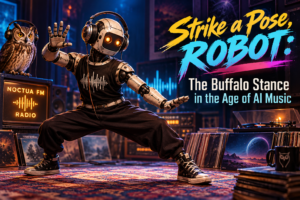
For a station such as Noctua FM Radio, this philosophy fits naturally with deep listening and ambient/electronic programming.
Imagine programming built around intentional listening journeys rather than conventional genre blocks.
The 6:00 AM Reset
Sparse ambient music moving gradually toward gentle electronic rhythm.
The Deep Work Transmission
Two hours of uninterrupted instrumental music selected for continuity rather than individual-track popularity.
The Unknown Hour
Music intentionally chosen outside the listener’s normal preferences.
Night Signals
Dark ambient, space music and long-form electronic compositions designed for late-night listening.
The Listening Society Session
One album, one hour, no skipping.
AI could help organize and analyze those programs.
But human curation would provide the philosophy.
That distinction is important.
The machine can search.
The machine can classify.
The machine can identify relationships.
The machine can propose sequences.
The human decides why the sequence should exist.
From Algorithmic Consumption to Intentional Listening
The first era of digital music was largely about access.
The second became about recommendation.
The next could be about intention.
That represents a subtle but profound shift.
Instead of asking:
What should I listen to?
we begin asking:
Why am I listening?
To concentrate?
To discover?
To understand another culture?
To think?
To remember?
To create?
To experience an entire album without touching a screen?
Or simply to sit quietly while music unfolds?
AI can help construct those environments.
But the destination remains human.
Perhaps the most valuable AI playlist will not be the one that understands our existing tastes perfectly.
It will be the one that occasionally challenges them.
The playlist that leads us somewhere unexpected.
The recording we would never have searched for.
The twenty-minute composition we initially thought was too long.
The unfamiliar artist who becomes important.
The hour when we finally stop skipping tracks.
Because personal growth has rarely come from endlessly repeating what we already know.
And neither has great listening.
The future of the playlist may therefore be less about predicting the next song we want to hear and more about helping us become better listeners.
In a culture overflowing with music, that may be the real revolution:
not discovering how to hear more—
but learning how to listen deeper.
About The Author